
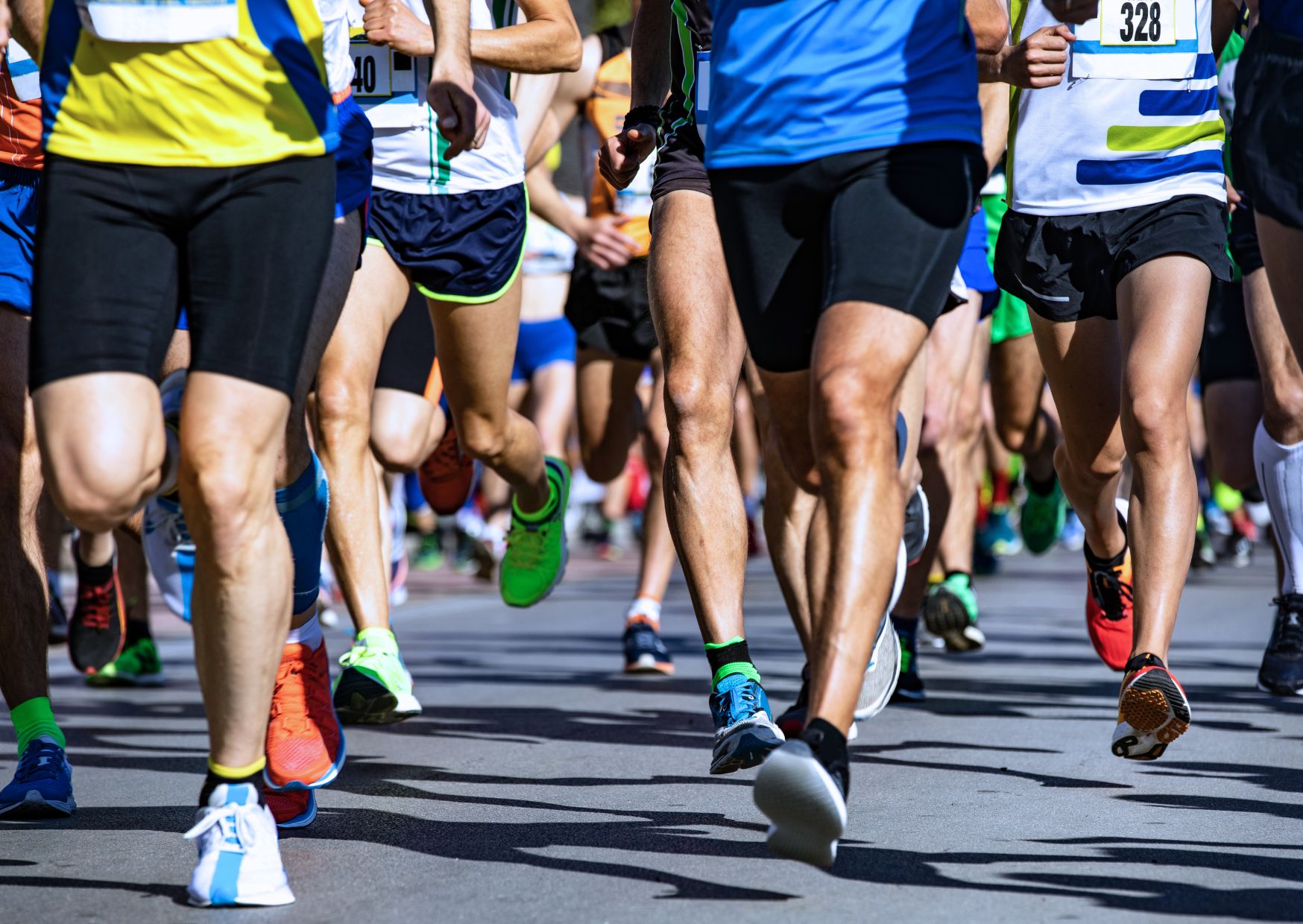
On 27 April 2026, at the London Marathon, two men – Sebastian Sawe (KEN) and Yomif Kejelcha (ETH) – managed to break the magical two-hour barrier for the 42.195 km distance. Alongside the ideal weather conditions and the undoubtedly impressive human achievement, another factor played a key role in making this record – a time long considered impossible – a reality. We are talking about the shoe, and specifically the sole and its development over recent years. It is also worth noting in this context that the 2026 London Marathon featured an all-women’s race, in which Tigst Assefa (ETH) also set a new world record of 2:15:41. Why are we mentioning this here? Precisely because she, too, was wearing the shoes that helped Sebastian Sawe and Yomif Kejelcha achieve their peak performances.
The long road to running a marathon in under 2 hours
Looking at the best times for the marathon over recent years, it can be seen that, for men, the record time remained at around 2:03:00 for a long time, before Eliud Kipchoge achieved a significant improvement in 2018 with a time of 2:01:39 (Table 1).
| Time | Name | Nation | Year | Location |
|---|---|---|---|---|
| 01:59:30 | Sabastian Sawe | KEN | 2026 | London |
| 02:00:35 | Kelvin Kiptum | KEN | 2023 | Chicago |
| 02:01:09 | Eliud Kipchoge | KEN | 2022 | Berlin |
| 02:01:39 | Eliud Kipchoge | KEN | 2018 | Berlin |
| 02:02:57 | Dennis Kimetto | KEN | 2014 | Berlin |
| 02:03:23 | Wilson Kipsang | KEN | 2013 | Berlin |
| 02:03:38 | Patrick Makau | KEN | 2011 | Berlin |
| 02:03:59 | Haile Gebrselassie | ETH | 2008 | Berlin |
| 02:04:26 | Haile Gebrselassie | ETH | 2007 | Berlin |
[1] Marathon world record: Men’s best times (as at 15 June 2026)
A similar trend can be observed among women. Paula Radcliffe’s 2003 world record of 2:15:25 stood for 16 years before Brigid Kosgei set a new record of 2:14:04 in 2019 (Table 2).
| Time | Name | Nation | Year | Location |
|---|---|---|---|---|
| 02:09:56 | Ruth Chepngetich | KEN | 2024 | Chicago |
| 02:11:53 | Tigst Assefa | ETH | 2023 | Berlin |
| 02:14:04 | Brigid Kosgei | KEN | 2019 | Chicago |
| 02:15:25 | Paula Radcliffe | GBR | 2003 | London |
| 02:17:18 | Paula Radcliffe | GBR | 2002 | Chicago |
| 02:18:47 | Catherine Ndereba | KEN | 2001 | Chicago |
| 02:19:46 | Naoko Takahashi | JPN | 2001 | Berlin |
[1] Marathon world record: Women’s best times (as at 15 June 2026)
It was precisely during this period that a renaissance in sole design began, which played a key role in enabling further records to be set in the years that followed.
Carbon – Foam midsole – Construction – Weight
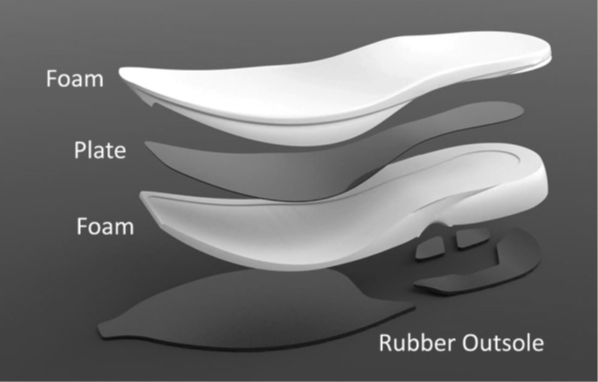
Specifically, the revolution began with the Nike Vaporfly 2017, which, for the first time, combined several components of the modern running shoe. First of all, there is the carbon fibre plate embedded in the sole. This serves to stiffen the otherwise soft cushioning of the sole, thereby compensating for instability and minimising energy loss with every step. In addition, the midsole was made from a foam that has been proven to return more elastic energy than the EVA foams used up to that point. The best-known example of these innovative foams is the thermoplastic elastomer Pebax, produced by Arkema. All major running shoe brands now have their own names for their ‘booster’ foams (a detailed overview can be found at [1]). In addition to these two materials, the construction of the sole also plays an important role. Independent studies have confirmed that the combination of foam, geometry and a carbon fibre plate can reduce the wearer’s energy expenditure by up to 4%.4 The resulting energy return properties therefore allow the wearer to run for longer whilst maintaining the same level of performance. Even back then, it was predicted that for top athletes, this energy saving could lead to a marathon time of under 2 hours.
[1] Hoogkamer, Wouter & Kipp, Shalaya & Frank, Jesse & Farina, Emily & Luo, Geng & Kram, Rodger. (2018). A Comparison of the Energetic Cost of Running in Marathon Racing Shoes. Sports Medicine. 48. 1–11. 10.1007/s40279-017-0811-2.
Another factor that significantly influences running economy is the weight of the shoe. For professional athletes, every gram counts. In long-distance races in particular, the weight becomes noticeably apparent in terms of running economy as the race progresses. The lighter the shoe, the easier it is for the wearer to maintain their pace over a longer period of time.
[1] The ultimate guide to running shoe foams | RunRepeat
Stack Height
Stack height refers to the total height of the outsole and midsole. With the development of modern ‘booster’ foams and their high energy return, manufacturers were tempted to maximise this effect, which has led to stack heights of up to 50 mm. Since 2020, World Athletics has limited the stack height of road running shoes to 40 mm. Looking at the top-of-the-range models from various running shoe brands, it is clear that they are operating at the upper limit of this restriction.
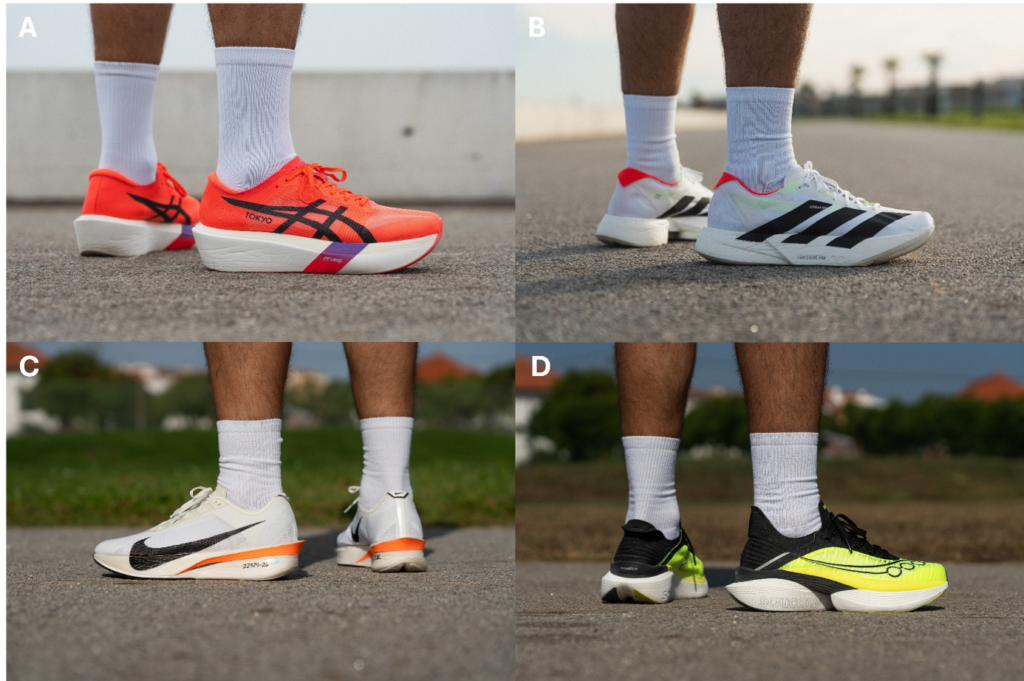
B: Adidas Adizero Adios Pro 4 (Stack Height 36,6mm)[2],
C: Nike Vaporfly 4 (Stack Height 34,1mm) [3],
D: Saucony Endorphin Elite 2 (Stack Height 39,9mm) [4]
[1] Cut in half: ASICS Metaspeed Sky Tokyo Review (2025) | RunRepeat
[2] Cut in half: Adidas Adizero Adios Pro 4 Review (2025) | RunRepeat
[3] Cut in half: Nike Vaporfly 4 Review (2025) | RunRepeat
[4] Cut in half: Saucony Endorphin Elite 2 Review (2025) | RunRepeat
The Adidas Adizero Adios Pro Evo 3
[1] adidas ADIZERO ADIOS PRO EVO 3 shoe – White | adidas Germany (as at 1 July 2026)
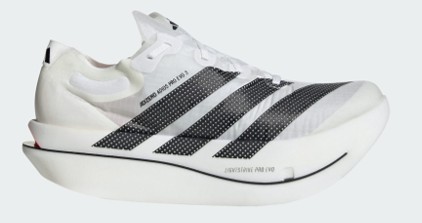
Sebastian Sawe (KEN), Yomif Kejelcha (ETH) and Tigst Assefa (ETH) all ran the London Marathon in this model. The fact that both men also broke the 2-hour barrier underlines that the shoe played a role in achieving this milestone that should not be underestimated.
But what exactly makes the Adidas Adizero Adios Pro Evo 3 stand out?
First and foremost, the weight of the shoe is worth mentioning. According to Adidas, the shoe weighs just 97 g, making it incredibly light. The weight saving alone is likely to have a noticeable impact on energy conservation during a marathon. Traditional running shoes usually weigh between 200 and 300 g. By limiting the stack height to 40 mm, the question arises as to how the energy return of the foams can still be maximised without compromising stability. Here, Adidas has developed an interesting solution in the form of the ENERGYRIM (see Figure 4).
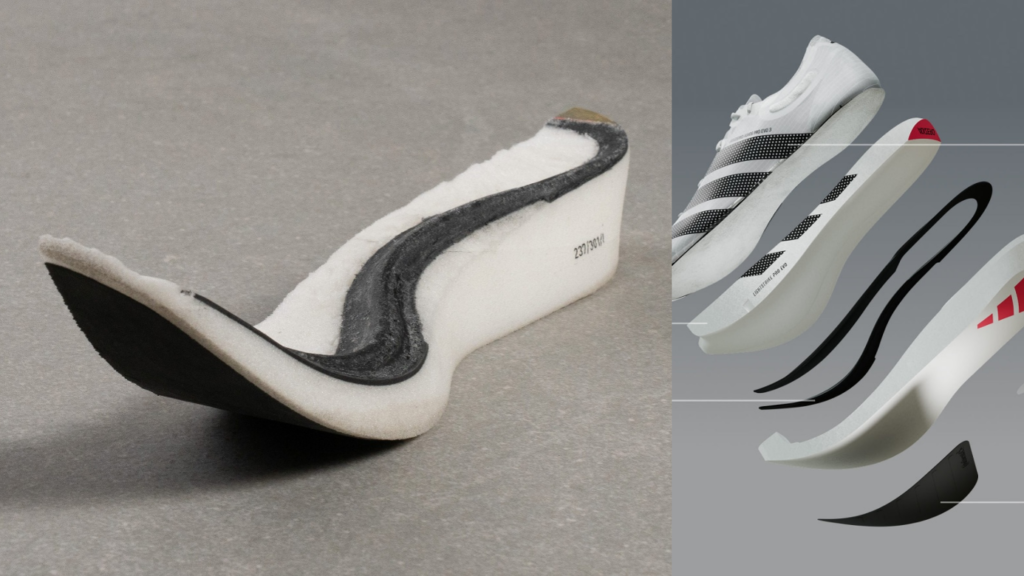
[1] Cut in half: Adidas Adizero Adios Pro Evo 3 Review (2026) | RunRepeat
Unlike the Nike Vaporfly described earlier, Adidas has not incorporated a continuous carbon fibre plate, but instead uses carbon selectively around the edge of the midsole (‘rim’). In this way, the stiffness of the carbon can still be utilised to stabilise the shoe and enhance energy return, whilst simultaneously reducing weight and allowing the foam to deliver its maximum cushioning and energy return properties. To achieve this, the permitted 40 mm stack height has been utilised almost to the full. According to Adidas, the stack height in the heel area is 39 mm. For the upper, Adidas has drawn inspiration from another sport. Here, the brand has incorporated elements from kitesurfing sails, which use similar yarns and must be both lightweight and tear-resistant. More elastic laces are also used, allowing for shorter laces and thus further weight savings. The necessary traction is provided by Continental’s expertise, which supplies the black rubber outsole for the forefoot section of the Adios Pro Evo 3.
Conclusion
With the Adizero Adios Pro Evo 3, Adidas has made marathon history and designed a technically impressive shoe that has optimised weight, propulsion and energy return to such an extent that marathon times of under 2 hours are a realistic prospect.
However, it must also be borne in mind that such high-tech products will initially be scarcely available on the mass market and are only of limited suitability for amateur runners for a number of reasons:
- Preis: Für die Topmodelle der Laufschuhanbieter muss das entsprechende Kleingeld bezahlt werden. Der Adidas Adizero Adios Pro Evo 3 wird aktuell mit einem Preis von 510€ gehandelt.
- Durability: Although high-performance foams such as Pebax offer excellent energy return, their performance characteristics begin to decline after around 400 km of running. In the pursuit of weight reduction, the upper materials are usually thin, partly to ensure adequate breathability for the foot. At the same time, however, this also makes them more susceptible to damage.
- Requirements: The carbon fibre plate and ‘Booster’ foam can have a particularly positive effect on experienced and well-trained runners. However, untrained runners, whose muscles and tendons are not accustomed to the way this ‘springy’ property works, face an increased risk of injury. Due to the high stack height and the soft midsole, the shoes have a certain degree of instability, which only subsides under greater strain at a high running pace of approximately 4 min/km.
- Running style: It has been shown, particularly for forefoot runners, that the full effect is achieved when the shoe incorporates a carbon fibre plate and ‘Booster’ foam.
It is certainly true that the potential for technical optimisation has not yet been fully realised. We are therefore keeping a close eye on the innovations that will be released in future and on how we, as PFI, can support and evaluate these further developments through biomechanical and laboratory tests.
Do you have any questions? Contact us!
Your Contact Person:

Dr. Ines Anderie
Chemical and Microbiological Analysis
Sign up for our newsletter to stay up to date.
Did you enjoy our blog article? Then sign up for our newsletter today! Published quarterly, it provides exciting insights into all things PFI. Stay informed about the latest topics in research, development, and testing—always up to date!
