
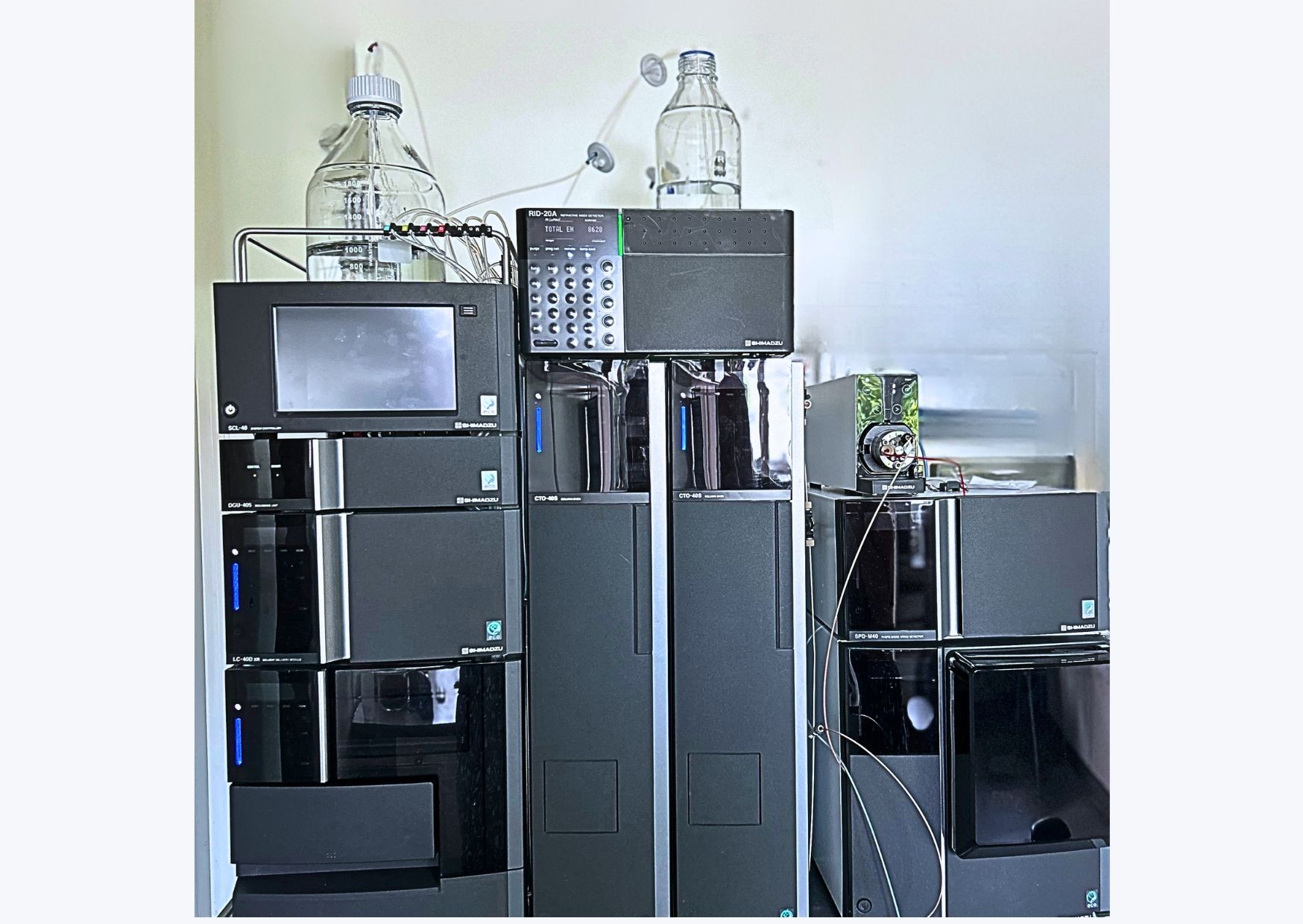
In June 2026, the time had come: the PFI’s Biotechnology Department was able to expand its analytical portfolio with a powerful new technology. The successful commissioning of a single-quadrupole mass spectrometer from Shimadzu enabled the existing HPLC (High-Performance Liquid Chromatography) system to be specifically upgraded and the range of analyses significantly expanded.
This will open up new possibilities for research in the future, enabling scientists to investigate complex biotechnological processes in even greater detail and to identify substances that have hitherto been difficult to detect.
Investment in modern research infrastructure
The new analysis module was acquired as part of a research project through the funding programme INNO-KOM under the Investment Grant (IZ) scheme. The funding programme supports non-profit industrial research institutions in expanding their scientific and technical infrastructure. The aim is to strengthen research and innovation, particularly in structurally weak regions, and to promote the transfer of scientific findings to industry. The PFI has been using this programme successfully for many years. Numerous pieces of research equipment have been procured in this way and used in a wide variety of projects. The now-upgraded HPLC system was also funded via INNO-KOM back in 2020.
Why modern analytics is so important
Biotechnology research projects regularly generate large numbers of liquid samples that need to be analysed. These often contain a wide variety of different substances – such as sugars, organic acids or other metabolic products. A typical example is fermentation processes, in which valuable bio-based chemicals are produced from renewable raw materials such as wheat straw. In order to control such processes effectively, scientists must continuously monitor which substances are present and in what concentrations. Only in this way can yields be improved, processes optimised and undesirable by-products detected at an early stage.
The role of HPLC
An HPLC system has been in use at the PFI for several years now for these tasks. High-performance liquid chromatography enables the separation, detection and quantification of constituents in liquid samples. The system has proved particularly effective in the analysis of sugars and organic acids. However, every analytical method eventually reaches its limits. Some relevant substances could not be detected, or only inadequately so, using the detector employed to date. For certain molecules, the system was, so to speak, ‘blind’.
More possibilities through mass spectrometry
This is precisely where the new single-quadrupole mass spectrometer comes into its own. By coupling it with the existing HPLC, it is now possible to detect significantly more substances than before. Furthermore, the system is considerably more sensitive, meaning that even very low concentrations can be reliably detected. This higher sensitivity is particularly important in research where individual compounds occur in very small quantities but have a decisive influence on biological or chemical processes.
How does a mass spectrometer work?
The basic principle of mass spectrometry is as elegant as it is effective: first, the molecules to be analysed are ionised. These ions are then analysed within the instrument and distinguished on the basis of their mass-to-charge ratio. This produces characteristic signals or fragmentation patterns that are unique to each compound. These ‘chemical fingerprints’ enable the substances present to be unambiguously identified. As a result, not only can known compounds be quantified, but previously unknown or unexpected substances can also be detected with significantly greater reliability.
New opportunities for research projects
The expansion of the analytical system opens up a significantly broader range of applications for the Biotechnology Department. The improved analytical capabilities enable:
- the investigation of new biotechnological processes,
- the analysis of more complex mixtures of substances,
- the detection of substances in minute concentrations,
- the exploration of new research questions,
- the development of related fields of research
This investment therefore not only strengthens the work of the Biotechnology Department, but also expands the scientific capabilities of the PFI as a whole.
Training for optimal use
To ensure that the new system can realise its full potential, Shimadzu will be providing comprehensive training in July. Staff will gain in-depth insights into mass spectrometry, as well as practical guidance on operating the equipment and analysing the measurement data. This will ensure that the new technology can be integrated quickly and efficiently into both current and future research projects.
An important step for the future
The expansion of the existing analytical capabilities through the addition of a state-of-the-art mass spectrometer is a further step towards the ongoing development of the research infrastructure at the PFI. Thanks to this increased analytical capacity, it will be possible in future to tackle even more complex scientific questions, carry out innovative research projects and gain new insights. In doing so, the PFI is laying the foundations for forward-looking research in the fields of biotechnology, sustainability and industrial innovation.
Do you have any questions? Feel Free to Contact Us!
Your Contact Person:

Dr. Stefan Dröge
Biotechnology
Sign up for our newsletter to stay up to date.
Did you enjoy our blog article? Then sign up for our newsletter today! Published quarterly, it provides exciting insights into all things PFI. Stay informed about the latest topics in research, development, and testing—always up to date!
