

Project Information
Duration:
1 July 2025 to 30 June 2028
Project Sponsors:
- Federal Ministry of Research, Technology and Space.
- WIR! programme (Change through Innovation in the Region)
- Project Management Jülich
Project Partners:
- Kaiserslautern University of Applied Sciences
- Technical University of Applied Sciences Augsburg
- Trier University of Applied Sciences





Initial situation & project description
Terrestrial cyanobacteria can be cultivated as immobilized biofilms in special reactors using small amounts of water and are capable of utilizing CO2 from flue gases. The overall objective of the project is the recovery of valuable materials using algae, exhaust gases, and residual materials.
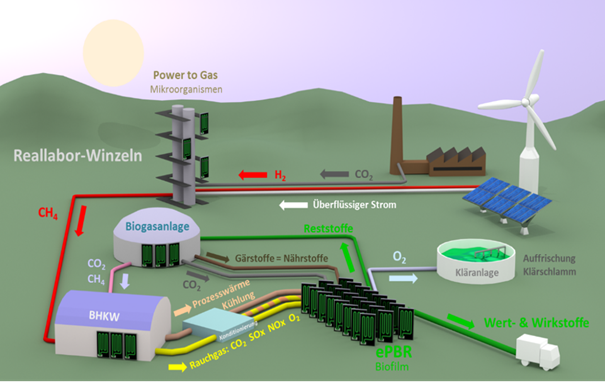
The overall objective of the joint project is to develop a process for producing algae biomass and valuable substances based on phototrophic fermentation using microalgae cultivated with sunlight, recycled CO2 from CHP combustion of biogases, and nutrients from fermentation residues. The flue gas produced during the energetic utilization of biomass promotes the growth of microalgae and can be used as a CO2 stressor, in particular for the targeted production of polyhydroxybutyric acid. Depending on the stressors selected, extracellular polymeric substances (EPS; primarily polysaccharides with predominant proportions of glucose, galactose, and mannose), as well as carotenoids (beta-carotene, echinenone, canthaxanthin) and the bioactive food colorants phycoerythrin and phycocyanin can also be obtained in the phototrophic fermentation process using cyanobacteria. The combination of extremophilic terrestrial cyanobacteria as immobilized biofilms and novel, air-fed (emergent) photobioreactors (ePBR), significant innovative barriers to algae- and microorganism-based value and active ingredient production based on submerged systems (low biomass and target product concentrations) can be overcome.
Within the joint project, the PFI focused on the characterization of flue gases and the development of fermentation residue-based growth media. The project partner, Kaiserslautern University of Applied Sciences, concentrated on the bioprocess engineering development of reactor technology (emergent biofilm photobioreactors [ePBR]) for coupling ePB reactors to combined heat and power plants. Augsburg University of Applied Sciences is responsible for plant design and planning, and Trier University of Applied Sciences is developing coupling variants on a pilot plant scale.
The project with the funding code FKZ 03WIR4513B is financially supported by the German Federal Ministry of Research, Technology, and Space (BMFTR) as part of the “WIR! Change through Innovation in the Region” funding program via the project management agency PtJ.
Any questions about the project?
Your Contact Person:

Dr. Stefan Dröge
Biotechnology
Sign up for our newsletter to stay up to date.
Did you enjoy our blog article? Then sign up for our newsletter today! Published quarterly, it provides exciting insights into all things PFI. Stay informed about the latest topics in research, development, and testing—always up to date!
