
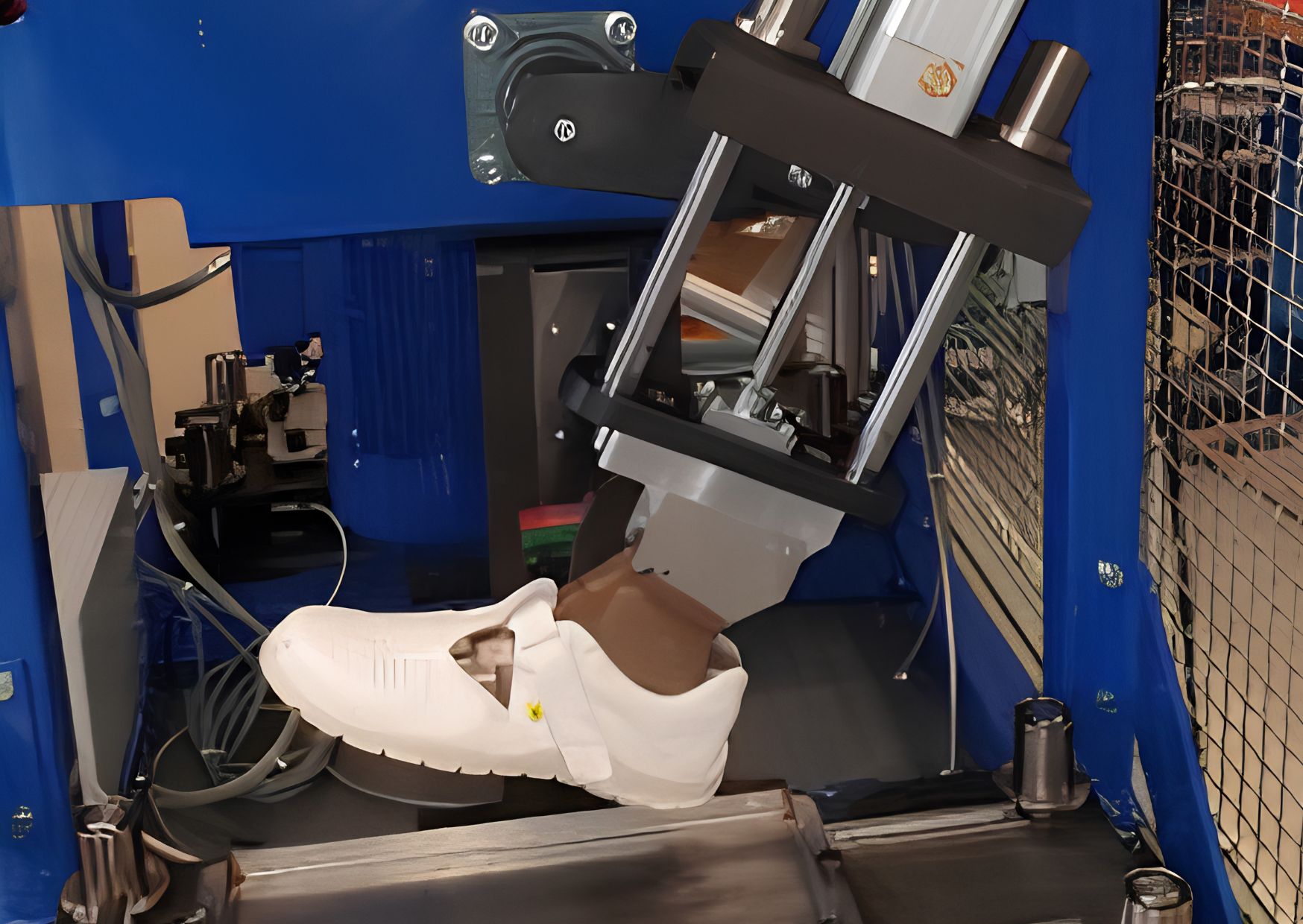
A shoe has to withstand a great deal in everyday life: the heel striking the ground thousands of times, the foot rolling forward, and the push-off from the forefoot – step by step, day after day. To ensure that we not only understand this strain but can also replicate it precisely in the laboratory, we have developed the gait simulator – a testing machine that mechanically replicates the human gait and puts shoes through their paces with a level of realism that few other methods can match.
As a testing and research institute for the footwear and leather industry, we have been working for decades on the question of how the quality and durability of footwear can be assessed objectively and transparently. Drawing on this long-standing experience, we have developed the gait simulator: an in-house innovation that provides our clients in the industry with an additional testing method that closely mirrors real-life conditions.
The human gait as a model
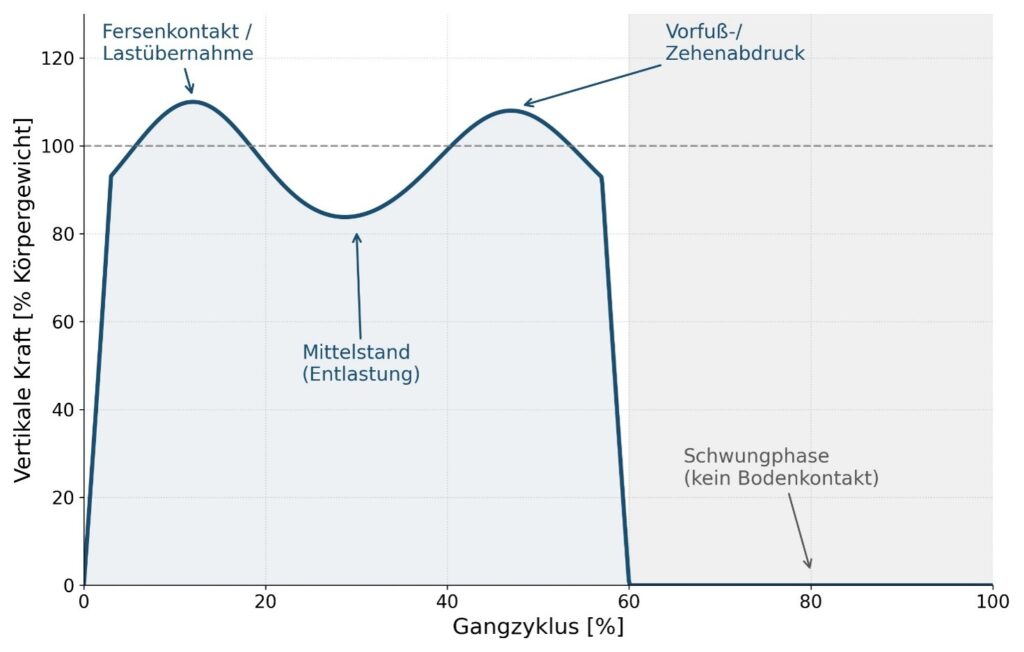
When walking, the weight is not distributed evenly across the foot, but follows a rhythm all of its own: as the heel strikes the ground, the force shoots steeply upwards; it drops briefly as the body rolls over the supporting leg; and then rises a second time as the foot pushes off the ground via the forefoot and toes. This characteristic up-down-up pattern – also known as a ‘double peak’ in gait analysis – reaches peak values of around 110 per cent of body weight at a normal walking pace, with a brief trough at around 80 per cent in between. When walking at a brisk pace or running, these force peaks are significantly higher. It is precisely this pattern that should serve as the benchmark for any realistic shoe test.
This is how the walking simulator replicates this rhythm
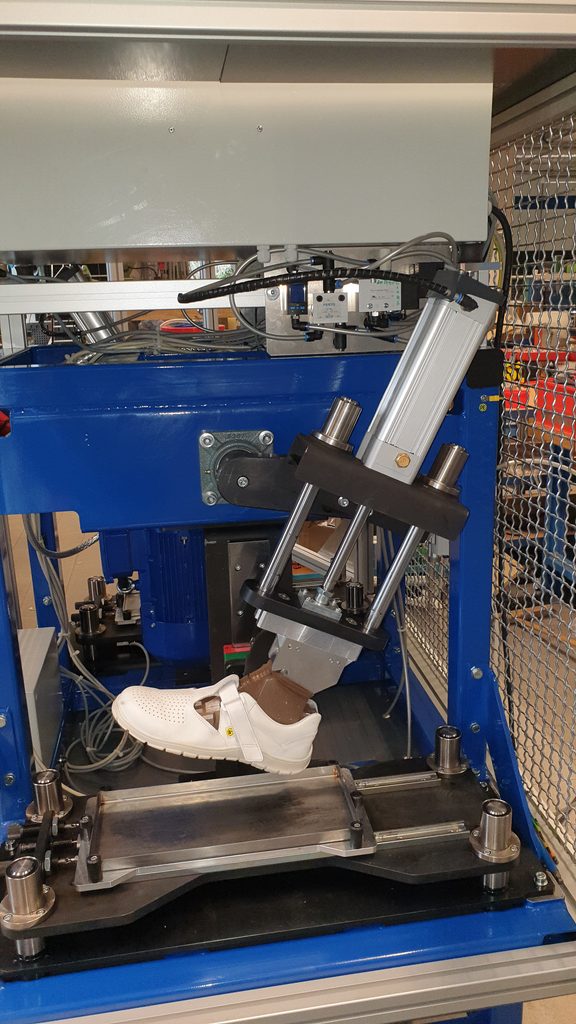
Our gait simulator features two independent test chambers, one for the left shoe and one for the right. A specially developed drive and control system ensures that the test specimen is subjected to exactly the same load at every stage of a step as a real foot would be when walking – from the transfer of weight upon heel strike to the powerful push-off via the forefoot.
During the test, force sensors continuously record the forces actually acting on the shoe and display the data in real time as a force-time curve. The result is astonishingly close to the actual gait curve: the software clearly shows two force peaks, separated by a brief trough – the mechanical fingerprint of a human step.
The system does not merely simulate a leisurely walk: the level and progression of the load can be specifically adjusted so that even brisk walking or running – with the correspondingly higher force peaks – can be replicated. And because, in real life, a shoe has to withstand not just one but millions of steps, the step simulator is designed for robust continuous operation: it carries out tests reliably and with consistent accuracy over a very large number of load cycles.
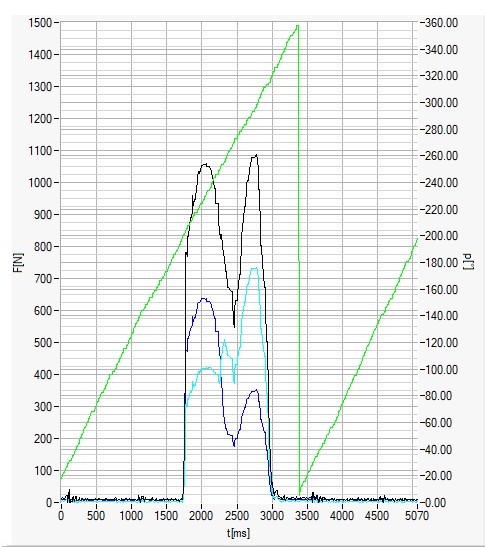
A comparison of the two curves highlights what makes the gait simulator so special: it does not merely apply a single, static load, but precisely reproduces the same pattern – an initial increase in force, a brief period of relief, followed by a second increase in force – that a human foot also generates whilst walking. It is precisely this correspondence in the temporal progression – not just in the magnitude of the load – that distinguishes our test method from conventional, one-dimensional compression or bending tests.
Why realistic testing makes all the difference
Whether it’s a work shoe, a sports shoe or an everyday shoe: ultimately, one thing matters most to wearers – that the shoe continues to perform reliably even after many thousands of steps. Traditional laboratory tests, which apply only a single, constant force, do not fully replicate these everyday conditions. If the test result deviates too far from real-world wear and tear, weaknesses may only become apparent to the end customer – with noticeable consequences for the complaints rate, the cost of rectification and, not least, confidence in a brand.
A test method that replicates the actual stress profile of a step fills precisely this gap. Weaknesses in the material or design thus become apparent in the laboratory before a product goes into mass production or a quality mark is awarded. For us as a testing institute, this is a key priority: to deliver results that genuinely reflect how a shoe behaves in real-world use – not just under laboratory conditions.
How manufacturers can use the step simulator
For footwear manufacturers and suppliers, this testing method opens up some very practical possibilities: when developing new sole materials or designs, it allows early identification of how a prototype behaves under walking loads similar to those encountered in everyday life – long before expensive field tests involving test subjects are required. In ongoing mass production, the system is used for quality assurance, for example to check whether different production batches maintain a consistent level of durability. And when comparing different shoe models or material variants, the gait simulator provides objective, reproducible performance metrics that can be compared with one another over long periods and across many test runs.
Precisely because the system simulates the entire load cycle of a step – rather than just a single test point – it complements traditional standardised tests by providing an additional, real-world perspective – an added value that translates into more robust development and quality decisions.
Overview
- Two independent test chambers for the left and right shoes
- Realistic simulation of the complete gait cycle rather than just individual load points
- Live force measurement and real-time curve display
- Reproducible long-term and fatigue tests over many cycles
- Adaptable to different gait patterns and load intensities – from leisurely walking to running
- Robustly designed for reliable endurance testing over millions of load cycles
- Comprehensive safety concept in accordance with the Machinery Directive
With the gait simulator, we go a step beyond traditional individual tests such as flex or abrasion tests: rather than simply examining an isolated material property, we simulate the entire stress cycle of a step – in a reproducible, documented manner that can be repeated as often as required. This provides manufacturers with reliable insights into how their shoes actually perform under real-world walking conditions.
Would you like to find out more about how the gait simulator can support your product development or quality assurance? Our team would be happy to advise you personally on the possible applications and the testing procedure at our institute.
Your Contact Person:

Peter Schultheis
Engineering
Sources:
1. DIN EN ISO 20344:2024-06 – Persönliche Schutzausrüstung – Prüfverfahren für Schuhe. www.dinmedia.de/de/norm/din-en-iso-20344/377668272
2. Velamed Medizintechnik: Bodenreaktionskräfte während der Standphase. velamed.com/bodenreaktionskraefte-waehrend-der-standphase
3. Physiopedia Multilingual: Gang – Definitionen. langs.physio-pedia.com/de/gait-definitions-de
The schematic performance curve was produced specifically for this article on the basis of these sources.
Sign up for our newsletter to stay up to date.
Did you enjoy our blog article? Then sign up for our newsletter today! Published quarterly, it provides exciting insights into all things PFI. Stay informed about the latest topics in research, development, and testing—always up to date!
