
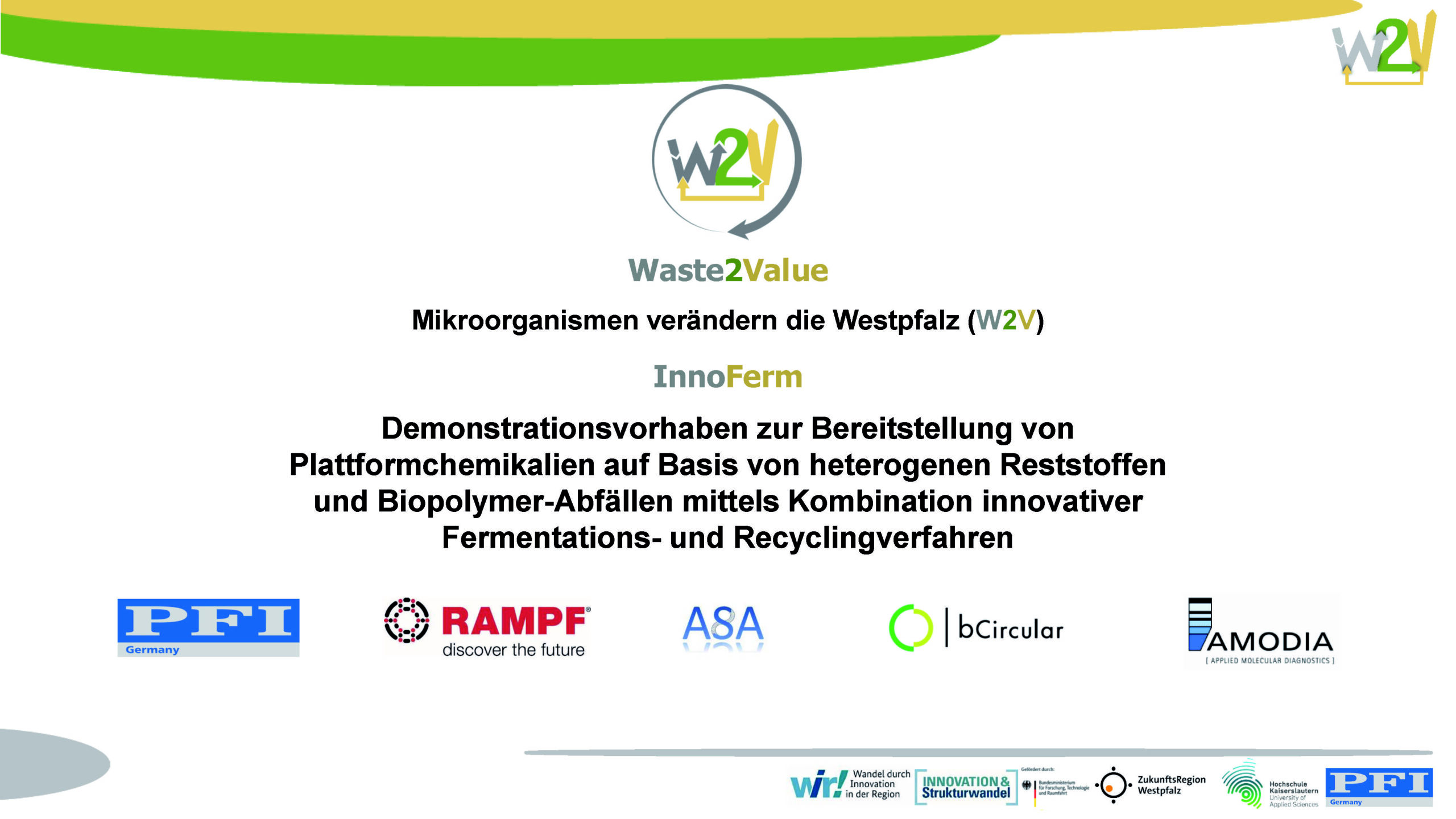
How can waste materials from agriculture, food production and plastic waste be turned into high-quality new products?
This is precisely the question addressed by the new demonstration project InnoFerm, which was started in May 2026. Together with four industry partners, the Pirmasens Testing and Research Institute (PFI) is working to translate innovative approaches from the fields of bio-based raw materials, fermentation technologies and chemical recycling into industrial practice.
Part of the Waste2Value alliance
InnoFerm forms part of the second funding phase of the regional innovation alliance Waste2Value, which has been supported since 2022 as part of the WIR! initiative of the Federal Ministry of Research, Technology and Space (BMFTR). The overall project has a budget of around three million euros and builds on the results of several successful research and development projects from the first funding phase. The aim is to scale up promising technologies from the laboratory to the demonstration and application stage.
Extracting valuable raw materials from waste materials
The project focuses on the use of various waste streams from agriculture and food production. Fermentation processes are used to produce what are known as platform chemicals. These serve as important feedstocks for the production of plastics and can help to partially replace fossil-based raw materials. But that is not all: monomers are also recovered from plastic waste. This is achieved using innovative chemical recycling processes, in which plastic residues are broken down into their basic chemical building blocks. The combination of these two approaches results in a particularly sustainable concept that combines bio-based and recycled raw materials.
Sustainable insulation materials as a goal
The building blocks obtained are then used to produce partially bio-based polyurethane foams (PU foams). Particular emphasis is placed on the development of novel rigid PU foams, which can be used as insulation material in the future. Such materials play an important role, for example, in the construction industry and in technical applications, and offer great potential for resource-efficient solutions. The aim of InnoFerm is to demonstrate that high-quality PU foams do not necessarily have to be based on fossil raw materials, but can also be produced through the intelligent use of waste materials and recycled materials.
Strong partners throughout the entire value chain
Implementing such a complex project requires a wide range of expertise from both the research and industrial sectors. That is why the InnoFerm consortium brings together experts from a variety of disciplines.
PFI and the biotechnology company ASA are contributing their expertise in the fields of fermentation and bioprocess engineering. AMODIA Bioservice GmbH supports process optimisation and control with its expertise in molecular diagnostics. RAMPF Advanced Polymers is responsible for the development of chemical recycling processes and the synthesis of the raw materials for PU foams. The consortium is complemented by bCircular, a specialist in raw material and waste management as well as life cycle assessments (LCA).
The project thus covers the entire value chain – from raw material extraction and material development through to the environmental assessment of the products.
From research to application
The project partners’ shared objective is clearly defined: after a 30-month project period, market-ready product prototypes are to be presented that demonstrate the potential of the technologies developed under real-world conditions. InnoFerm serves as a prime example of how research, industry and sustainability can work together to develop innovative solutions for the circular economy. Through the intelligent use of bio-based and recycled raw materials, the project is making an important contribution towards a resource-efficient and climate-friendly plastics industry.
A look into the future
The challenges of the future call for new approaches to the use of raw materials. Projects such as InnoFerm demonstrate that what is often regarded as waste can in fact be a valuable resource. By combining fermentation, chemical recycling and modern materials development, innovative material solutions are created that combine sustainability with industrial applicability.
Any questions about the project? Feel Free to Contact Us!
Your Contact Person:

Dr. Stefan Dröge
Biotechnology
Sign up for our newsletter to stay up to date.
Did you enjoy our blog article? Then sign up for our newsletter today! Published quarterly, it provides exciting insights into all things PFI. Stay informed about the latest topics in research, development, and testing—always up to date!
