
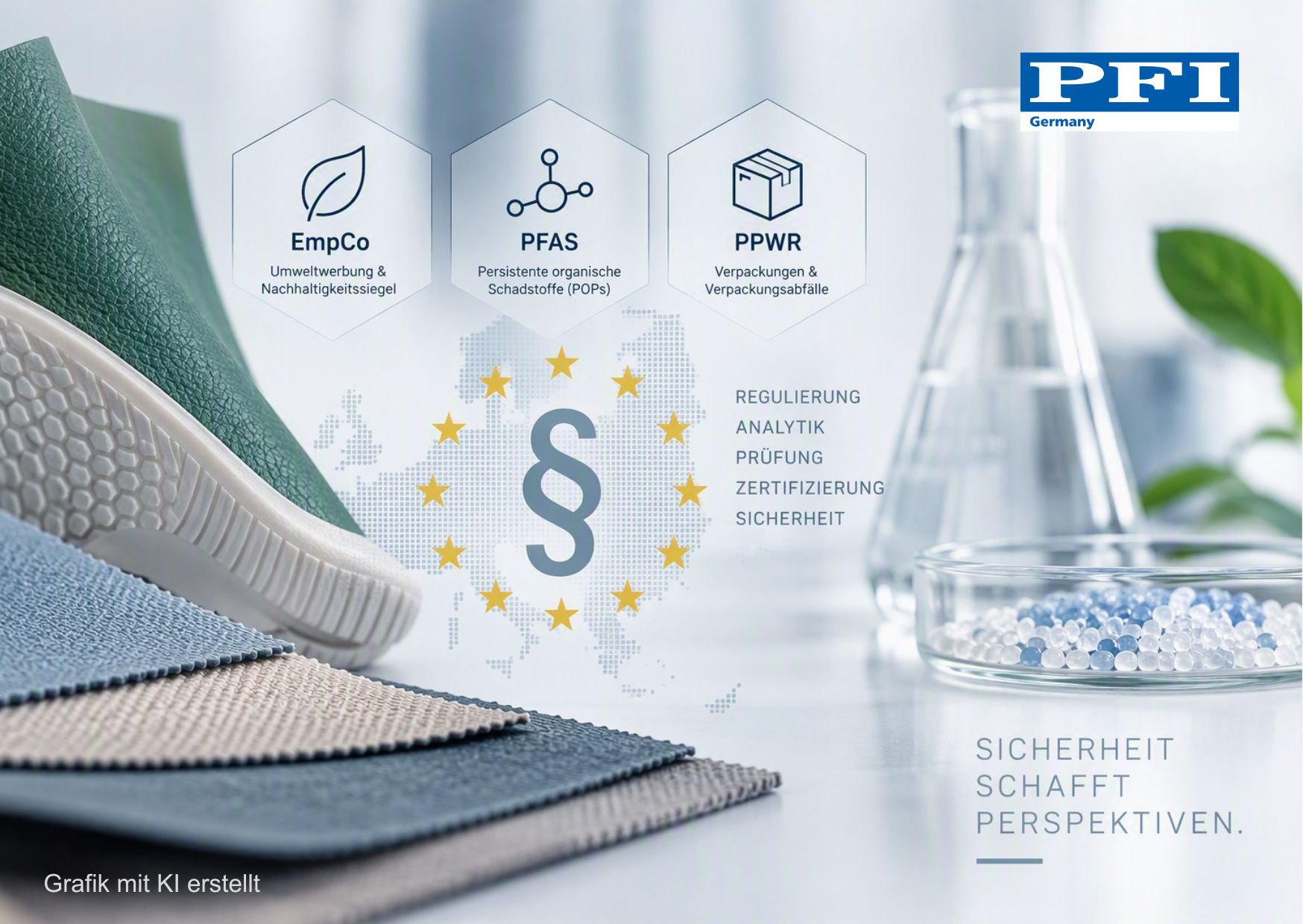
Regulatory developments in the second half of 2026 are currently a focus for numerous companies in the footwear, leather, textile, plastics and packaging industries. New European and national regulations range from stricter requirements for environmental advertising and additional restrictions on harmful substances to expanded regulations on packaging.
The Testing and Research Institute Pirmasens e.V. (PFI) helps companies to identify regulatory requirements at an early stage, assess them reliably and implement them safely through independent testing and certification.
New requirements for environmental advertising and sustainability labels
The so-called EmpCo Directive (EU) 2024/825 significantly tightens the requirements for environmental claims and sustainability labels. The new provisions will apply from 27 September 2026. In Germany, implementation will take place through amendments to the Unfair Competition Act (UWG). The aim of the regulation is to better protect consumers from misleading environmental and sustainability claims. In future, companies must check particularly carefully whether the claims and sustainability labels they use comply with the legal requirements.
Although the regulations are directly aimed at communications with consumers, businesses should take into account the implications for their overall marketing communications. Statements originally intended solely for the B2B sector could be passed on along the supply chain and and thus later appear in consumer communications. The PFI marks of approval and the underlying certification procedures have already been brought into line with the requirements of the EmpCo Directive.
New POP restrictions on PFAS and chlorinated paraffins
The European Commission has also adopted new rules to include further groups of substances in the Regulation on Persistent Organic Pollutants (POPs Regulation).
Extended restrictions on long-chain PFAS
In future, the existing restrictions on long-chain perfluorocarboxylic acids (C9–C14-PFCAs) are to be extended to cover further PFAS compounds up to and including C9-C21. The following limit values are planned:
- C9–C21 Perfluorocarboxylic acids and their salts: sum 25 µg/kg
- compounds related to C9–C21 Perfluorocarboxylic acids: sum 260 µg/kg
This development demonstrates once again that PFAS remain a key focus of European chemicals regulation. Companies should review their supply chains and materials at an early stage to identify any potential impacts.
New limit values for medium-chain chlorinated paraffins (MCCP)
There are also plans to include medium-chain chlorinated paraffins (MCCPs) in the POPs Regulation. A limit value of 1,000 mg/kg is proposed for the total of linear C14–C17 chloroalkanes. MCCPs are used, amongst other things, as flame retardants or plasticisers in plastics.The new requirements could lead to challenges, particularly regarding the use of recycled materials, as MCCP residues from older material streams can find their way into recyclates. In the leather industry, too, MCCPs may occasionally be used as fattening agents, although evidence of this is relatively rare.
PPWR: New EU Packaging Regulation
The new EU Packaging Regulation (PPWR) has been in force since 12 August 2026. The aim of the regulation is to make packaging more sustainable and to promote the transition to a circular economy.
Chemical requirements for packaging materials have also been laid down:
Heavy metals remain limited
Furthermore, a limit of no more than 100 mg/kg applies to packaging for the total content of heavy metals:
- Cadmium
- Lead
- Mercury
- Chromium VI
For many companies in Germany, this requirement is nothing new, as similar regulations have been in place for years.
New PFAS requirements for food packaging
However, specific limit values for PFAS and for the total fluorine content (Total Fluor) in certain packaging applications are new. The regulations initially apply only to food packaging and increase the need for appropriate analytical testing throughout the entire supply chain.
Taking action early ensures security
Current developments show that regulatory requirements in Europe are continuing to increase. In particular, the issues of environmental communication, PFAS, persistent pollutants and packaging safety are currently the focus of legislation.
Companies should assess the impact on products, materials and communications at an early stage. PFI provides support in this regard through testing, analysis, certification and expert advice, with a view to minimising regulatory risks and taking current and future market requirements into account at an early stage.
Do you have any questions about the latest developments, or would you like to have your products and materials assessed to ensure they meet the new requirements? Please feel free to contact us.
Your Contact Person:

Dr. Ines Anderie
Chemical and Microbiological Analysis
Sign up for our newsletter to stay up to date.
Did you enjoy our blog article? Then sign up for our newsletter today! Published quarterly, it provides exciting insights into all things PFI. Stay informed about the latest topics in research, development, and testing—always up to date!
