
Process development for the design of work and safety shoes using numerical simulation taking into account dynamic loads
Project Information
Duration:
1 October 2020 to 31 December 2022
Project Sponsors:
- Federal Ministry of Economics and Technology
- Aif - Alliance for Industry and Research
- IGF – Industrial Collective Research


Initial situation & project description
Work and safety shoes must meet numerous legal requirements, making it very challenging for designers to find a compromise between maximum protection and the greatest possible flexibility. This compromise can only be achieved through extensive trial and error. However, this often leads to over-engineering and long development times for new shoe models in SMEs. The goal of the research project is therefore the development, testing and validation of simulation models for the realistic representation of shoe components and complete shoes from the technical sector (work and safety shoes) in their static and especially dynamic behavior.
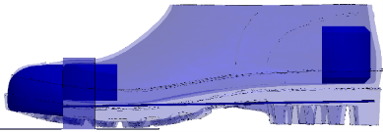
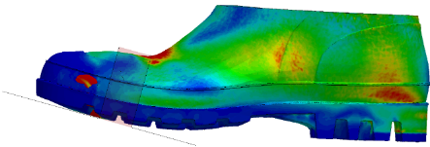
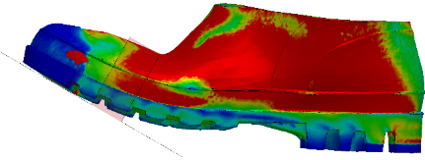
Fig. 1: Simulation of the flexibility test with cap and insert
This provides SMEs in the German footwear industry with a simulation toolkit that enables them to virtually test new material combinations and construction methods and to develop innovative and customized shoes. At the ITM (Institute for Textile and Mechanical Engineering), FEM simulation models of individual shoe components with various material combinations are created for this purpose. In addition, a universally applicable and parameterized shoe model is developed. The starting point is the designs from the shoe CAD systems already available at the SMEs. The FEM models are validated in comparison to experimental tests, taking into account the following tests: drop hammer test, rollover test, and flexibility test of a shoe (torsional and bending load). These powerful testing methods are further developed at the PFI (Institute for Product Research and Innovation). Finally, parameter studies are conducted with the validated models. Parallel to the model development, a database of materials frequently used in shoes, already at the PFI, is being expanded and made available to the SMEs. Procedures for the SMEs are being created based on numerical parameter studies, and the economic viability of the developed FEM-based process chain is being analyzed. The overarching goal pursued is to make simulation methods accessible to SMEs in the shoe industry and related sectors in order to significantly strengthen their innovation potential.
The project objective was successfully achieved.
We would like to express our gratitude for the funding provided for the research project IGF Project No. 21374 BG, which was funded as part of the programme to promote Industrial Collaborative Research (IGF) through the AiF using funds from the Federal Ministry of Economics and Technology following a resolution of the German Bundestag.
We also extend our sincere thanks to all companies and their employees for their active support in the execution of this project.
Final Report
The full final report can be requested as a PDF by emailing marketing@pfi-germany.de for a small fee.
Do you have any questions about the project?
Your contact:

Thorsten Knierim
Research & Engineering
Sign up for our newsletter to stay up to date.
Did you enjoy our blog article? Then sign up for our newsletter today! Published quarterly, it provides exciting insights into all things PFI. Stay informed about the latest topics in research, development, and testing—always up to date!
