
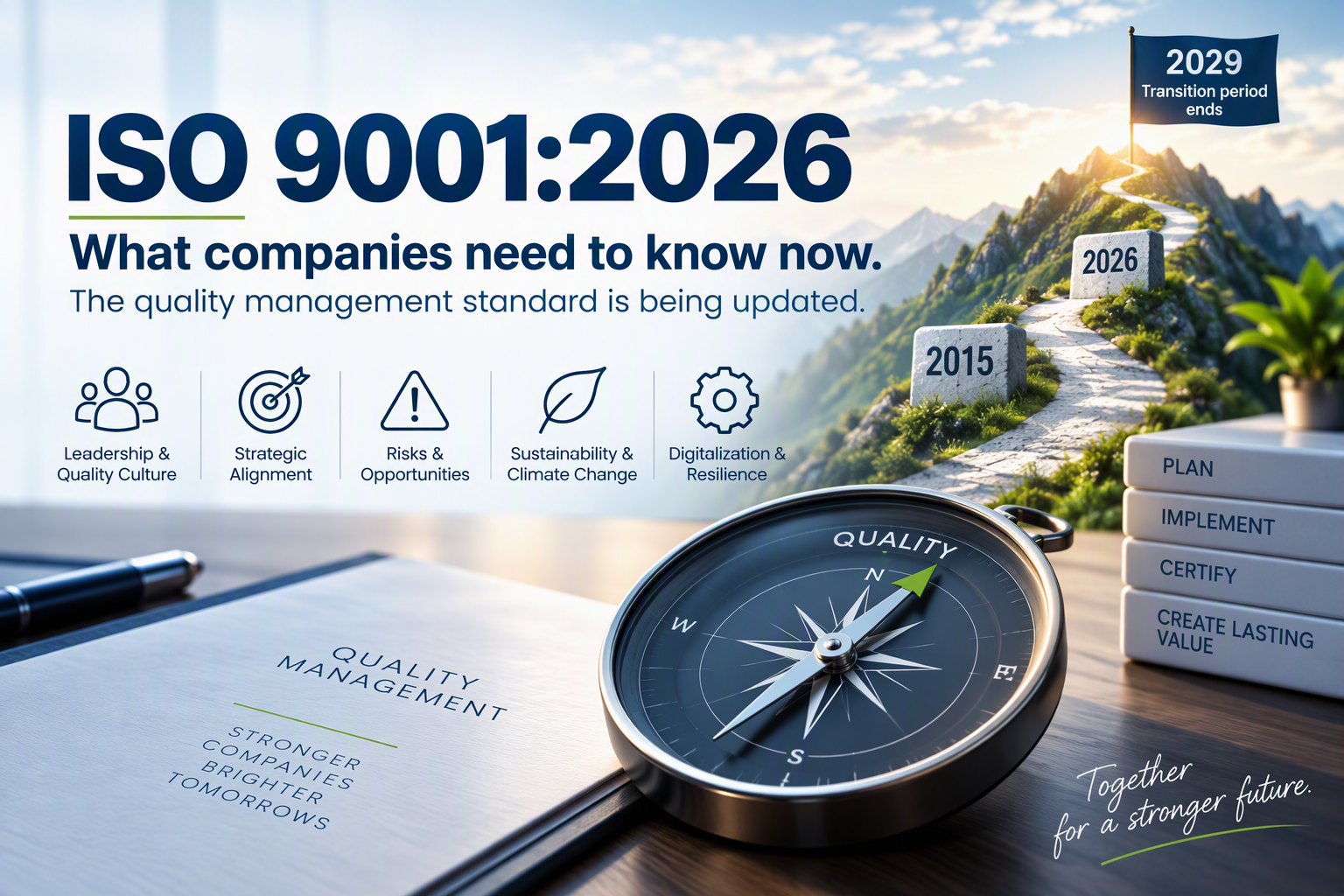
On 16 September 2026, the new edition of ISO 9001 was published. The German-language edition is scheduled for November 2026. It replaces ISO 9001:2015. The revision builds on the existing quality management system and, in particular, clarifies and reinforces leadership, quality culture, alignment with strategy, and the management of risks and opportunities.
Important:
- The transition period ends on 30 September 2029 (subject to final confirmation by the Global Accreditation Cooperation Incorporated (Global ACI, formerly IAF))
- Certificates issued under ISO 9001:2015 will cease to be valid after that date.
- Making the switch early provides planning certainty and avoids time pressure.
What changes will ISO 9001:2026 bring?
- Greater focus on leadership and a quality culture
The standard emphasises the responsibility of top management for fostering an effective quality culture. It also highlights ethical behaviour, accountability and an environment in which staff contribute to the effectiveness of the quality management system. The organisation must determine whether climate change is a relevant issue. This was already mandatory in Annex ISO 9001/A1:2024-1 and has now been incorporated.2 - Quality policy more closely linked to strategy
The quality policy is explicitly linked more closely to the context and strategic direction of the organisation. The quality management system is thus intended to contribute more clearly to the achievement of the organisation’s objectives. - Distinguishing more clearly between risks and opportunities
The revised standard provides greater clarity on how to manage risks and capitalise on opportunities. Both aspects are to be incorporated more effectively into informed decision-making and continuous improvement. - Raising staff awareness
The requirements regarding awareness place greater emphasis on the culture of quality and ethical behaviour. This makes it clearer how people contribute to the effectiveness of the quality management system. - Harmonised structure and improved clarity
ISO 9001:2026 follows the current Harmonised Structure for management system standards. A new informative Annex A explains the terms, concepts and the intent behind the requirements, and is intended to facilitate consistent application. - Clarifications and updates for today’s business reality
In addition to the key areas, numerous formulations and interrelationships have been clarified. Among other things, ISO cites digitalisation, organisational knowledge, complex supply chains and resilience as relevant contextual factors.
Your potential timetable for the transition
- Define responsibilities: Appoint those responsible for the transition and involve senior management at an early stage.
- Understanding the requirements: Compare ISO 9001:2026 with your existing quality management system and identify the changes that are relevant to your organisation.
- Carry out a gap analysis: Pay particular attention to leadership and quality culture, alignment with strategy, risks and opportunities, awareness, as well as the updated structure and explanatory notes. Identify the gaps in your documented processes.
- Implement measures: Adjust processes, responsibilities and documented information where necessary in light of the new or clarified requirements.
- Involving staff: Ensure that relevant managers and staff understand the changes and their role in ensuring the effectiveness of the quality management system.
- Check effectiveness: Use internal audits and management reviews to check the implementation and effectiveness of the adjustments.
- Plan your certification in good time: Coordinate the transition to ISO 9001:2026 with your certification body at an early stage. The transition can take place as part of a surveillance or recertification audit, or through a separate transition audit.
What will happen to my certificate?
If a re-certification audit is still being carried out in a company in accordance with the old standard, the certificate’s validity will always expire on 30 September 2029 (subject to final confirmation by the Global Accreditation Cooperation Incorporated (Global ACI, formerly IAF)).
Following successful implementation and confirmation (e.g. during the surveillance audit), the validity of the certificate is re-determined on the basis of the certification date within the current 3-year cycle.
Example:
- Re-certification to the previous standard (9001:2015) on 3 December 2026 -> Certificate valid until 30 September 2029
- Follow-up audit in accordance with the new standard (9001:2026) on 3 December 2027 -> new expiry date: 2 December 2029
PFI will support you through the transition
As an accredited certification body, PFI Certification supports organisations in successfully transitioning to ISO 9001:2026. Our auditors support you with their experience, practical expertise and a clear understanding of the new requirements.
Our tip: Start your gap analysis early. This will enable you to make the most of the transition period and ensure that your certification remains valid.
Your Contact Person:

Dr. Gunder Dörr
Certification and
Quality Management
Sign up for our newsletter to stay up to date.
Did you enjoy our blog article? Then sign up for our newsletter today! Published quarterly, it provides exciting insights into all things PFI. Stay informed about the latest topics in research, development, and testing—always up to date!
