
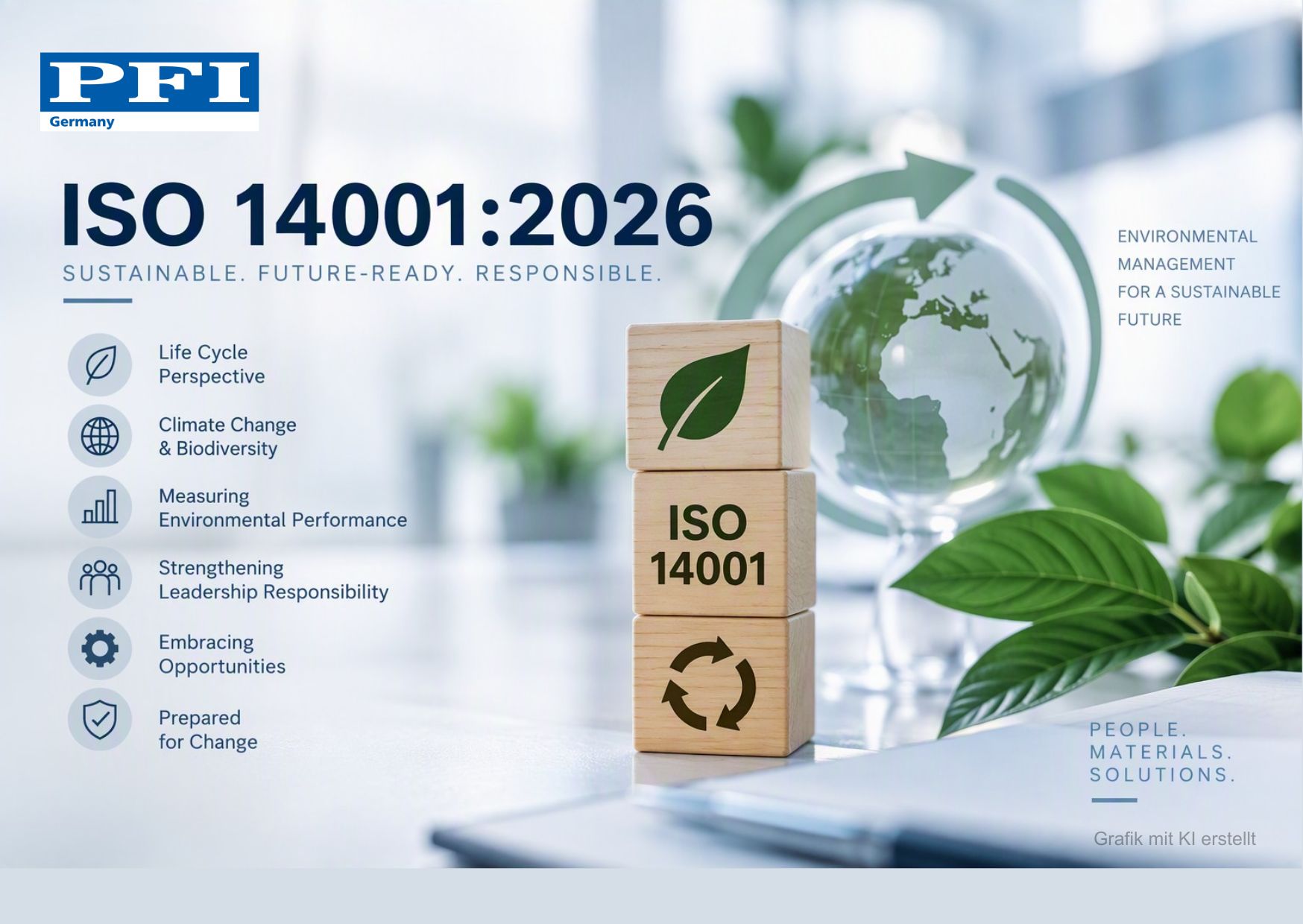
ISO 14001:2026 was published on 15 April 2026 and introduces a number of changes to environmental management systems. Organisations certified to ISO 14001:2015 have until 30 April 2029 to implement the new requirements.
Important:
- The transition period ends on 30 April 2029 (36 months).
- Certificates issued under ISO 14001:2015 will cease to be valid after that date.
- Making the switch early provides planning certainty and avoids time pressure.
What changes will ISO 14001:2026 bring?
- Greater focus on the entire life cycle
Companies should consider environmental aspects throughout the entire life cycle of products and services – from procurement through to manufacture, use and disposal. - Taking climate change and biodiversity more fully into account
Environmental and climate risks, as well as their impact on biodiversity, should be systematically assessed and taken into account in decision-making. - Greater accountability on the part of the management
Top management must integrate environmental objectives and environmental performance more closely into the corporate strategy. - Identifying and capitalising on opportunities
In future, the focus will be not only on risks but also on opportunities, for example:
- Resource efficiency
- Circular economy
- Innovations
- Sustainable business models
Your potential timetable for the transition
- Define responsibilities: Appoint a project team and involve top management at an early stage.
- Understanding the requirements: Familiarise yourself with the new regulatory requirements and deadlines.
- Carry out a gap analysis: Compare your existing management system with the requirements of ISO 14001:2026 and identify the gaps in relation to the new standard.
- Implement measures: Based on the gaps identified, make targeted adjustments to processes, assessments and documentation.
- Training staff: Ensure that relevant staff are informed and trained in good time.
- Check effectiveness: Use internal audits and management reviews to check the implementation and effectiveness of the measures.
- Plan your certification in sufficient time: Agree the transition date with your certification body well in advance.
What will happen to my certificate?
If a re-certification audit is still carried out in a company in accordance with the old standard, the certificate’s validity will always expire on 30 April 2029. Following successful implementation and confirmation (e.g. during the surveillance audit), the certificate’s validity will be re-established on the basis of the certification date within the current three-year cycle.
Example:
- Re-certification to the previous standard (14001:2015) on 3 November 2026 -> Certificate valid until 30 April 2029
- Überwachungsaudit nach neuer Norm (14001:2026) am 03.11.2027 -> neues Ende der Gültigkeit: 02.11.2029
PFI will support you through the transition
As an accredited certification body, PFI supports organisations in successfully transitioning to ISO 14001:2026. Our auditors support you with their experience, practical expertise and a clear understanding of the new requirements.
Our tip: Start preparing well in advance. This will enable you to make the most of the transition period and ensure that your certification remains valid.
Your Contact Person:

Dr. Gunder Dörr
Certification and
Quality Management
Sign up for our newsletter to stay up to date.
Did you enjoy our blog article? Then sign up for our newsletter today! Published quarterly, it provides exciting insights into all things PFI. Stay informed about the latest topics in research, development, and testing—always up to date!
